
G+35 tower design: the engineering behind India's new high-rises.
India's new luxury residential market is converging on the G+35 typology — a thirty-five-floor residential tower with four to six homes per floor. Forbes Fab Luxe Residences will deliver eleven such towers on a 13-acre site in Sector 4, Greater Noida West. Most marketing for these projects describes them as "high-rise" without explaining what changes structurally between a low-rise (G+8), a mid-rise (G+15 to G+25) and a high-rise (G+30 and above). This brief explains the structural systems that define a G+35 in India — the foundation, the lateral system, the wind tunnel work, the lift design and the fire compartmentation. It is written for buyers and consultants who want to understand the engineering substance behind the building height.
The height threshold, and why G+35 is a regime change.
Indian high-rise buildings are categorised by the National Building Code 2016 (NBC 2016) by height: above 15 metres is high-rise; above 50 metres requires fire-tender access lift; above 70 metres requires refuge floor; above 100 metres triggers the wind tunnel and structural review board provisions. A G+35 tower, at typical floor-to-floor of 3.2 metres, sits at approximately 112 metres above ground — comfortably above the 100-metre threshold that changes the regulatory regime. From that point onward, every structural system is in the high-rise envelope. Lateral loads dominate. The foundation transitions from raft to piled raft. The lift becomes a destination-control gearless. The fire system requires sprinklers, pressurised stairs and a refuge floor. Each of these is a real cost line, and each is the reason a G+35 luxury residence is engineered, not merely constructed.
The foundation — raft, pile, or both.
The foundation choice for a G+35 tower is determined by the soil, not by the architect. The geotechnical investigation includes boreholes to a minimum depth equal to 1.5 times the building width or 30 metres, whichever is greater. For Greater Noida West, the founding stratum is dense alluvial sand with intermittent silt lenses. Bearing capacity at 2 metres depth is approximately 200 to 250 kN/m². For an eleven-tower G+35 project the per-tower load at base is roughly 250,000 to 300,000 kN. A simple isolated footing system is structurally untenable at that load. The standard solution is one of three: a thick raft (1.8 to 2.4 metres) directly on the bearing stratum, a piled raft with friction piles down to 25 to 30 metres, or a fully piled foundation with a thinner raft tying the pile heads. The piled raft is the most common choice for G+35 in NCR because it controls differential settlement to under 25 mm across the tower footprint. Forbes Fab Luxe uses a piled raft system; the pile sizes and the raft thickness are sized to the tower-specific load and are reflected in the structural specification.
The lateral system — shear walls, cores and outriggers.
The structural problem in a G+35 tower is not vertical — gravity loads are conventional — but lateral. Wind and seismic loads at the top of a 112-metre tower produce drift, deflection and shear forces that scale non-linearly with height. The structural system must control them all. The dominant lateral system in Indian G+35 design is the reinforced concrete shear wall and core. The lift shafts and the staircase wells are wrapped in 300 to 400 mm thick RC walls that act as vertical cantilevers, picking up the lateral load and delivering it to the foundation. The shear walls are detailed with confined boundary elements — a tightly tied vertical reinforcement zone at each end of the wall — to provide ductility under cyclic loading. This is the IS 13920 ductile detailing requirement and is non-negotiable in Seismic Zone IV. Related: G+35 seismic engineering for Indian zones.
For taller towers (G+40 and above), the shear wall system alone may not be sufficient to control inter-storey drift. Engineers introduce an outrigger or a belt truss at one or two intermediate floors. The outrigger is a deep beam or a steel truss that connects the central core to the perimeter columns, making the perimeter participate in the lateral resistance. The belt truss runs around the perimeter at a single floor and stiffens the entire ring. Both systems shorten the effective lever arm of the lateral load and drop the top deflection by 30 to 50 per cent. On a G+35, the outrigger is sometimes economical but rarely structurally necessary; the shear wall and core handle the load. On a G+40 to G+50, it is a routine inclusion.
The slab — post-tension or conventional.
The floor slab in a G+35 tower must support the gravity load (live + dead + finishes), tie the perimeter columns into the core for lateral participation (the diaphragm action) and limit deflection to L/360 or better. The two competing solutions are conventional RCC and post-tensioned concrete. A conventional RCC slab at G+35 is typically 200 to 240 mm thick with a span of 6 to 7 metres. A post-tensioned slab can span 9 to 11 metres at 200 mm thickness. For a luxury 3 BHK plan with an 11-metre clear span, post-tension is the only economically viable solution. The result for the buyer is open living-dining-kitchen volumes without intermediate columns. Related: post-tension vs conventional slabs.
The wind tunnel — a 100-metre rule.
For any structure above approximately 100 metres in height (or with significant slenderness), IS 875 Part 3 (and current global practice) requires a wind tunnel test. The test is conducted on a 1:300 to 1:500 scale rigid model in a boundary-layer wind tunnel, with the surrounding terrain and adjacent buildings included. Three measurements are produced: high-frequency force balance data (base shears and base moments), aeroelastic data (top-floor accelerations under occupant comfort criteria) and pressure-tap data (cladding pressures by zone). The base shear and moment data feed into the structural design and typically reduces the lateral load envelope by 10 to 20 per cent compared to a code-only computation, because the wind tunnel accounts for shielding by adjacent structures. The cladding pressure data feeds into the façade design — every glass panel, every spandrel and every gasket is sized to the local wind pressure including the suction peaks at the corners.
| Parameter | Typical value | Code reference |
|---|---|---|
| Building height | ~112 m | NBC 2016 Part 4 |
| Wind speed (basic) | 47 m/s (Vb) | IS 875 Part 3 |
| Seismic zone | IV | IS 1893 |
| Response reduction (R) | 4 (SMRF + walls) | IS 1893 |
| Allowable inter-storey drift | 0.004 h | IS 1893 |
| Maximum top deflection | H/500 | IS 875 Part 3 |
| Concrete grade (walls/columns) | M50 to M60 | IS 456 |
| Steel grade | Fe 500D, Fe 550D | IS 1786 |
| Wind tunnel required | Yes (>100 m) | IS 875 Part 3 |
The lifts — the building's circulation engine.
A G+35 lift is not a scaled-up G+5 lift. The travel distance is roughly twenty times higher; the rope length, the counterweight, the motor torque and the door cycle time all change. The standard residential G+35 lift speed is 2.5 to 3.5 metres per second. At 2.5 m/s, a top-floor-to-ground non-stop run is under 50 seconds; at 3.5 m/s, under 35 seconds. The lift type is gearless permanent-magnet synchronous machine, machine-room-less (MRL), with destination control. Destination control assigns each passenger to a specific lift based on the floor button pressed at the lobby — this halves the wheel-of-stops on a peak morning down-cycle and is the single largest waiting-time improvement available to a G+35. On Forbes Fab Luxe, each tower has four passenger lifts plus a service lift, sized for a peak handling capacity of 12 per cent of population in 5 minutes — which is the LEED Silver / Indian Green Building Council standard for residential.
Fire compartmentation — the silent system.
Above 50 metres, a residential tower must be fully sprinklered, with pressurised staircases and a refuge floor at every 24 metres of height. On a G+35, a refuge floor is required at approximately floor 8 and floor 16 (and sometimes also at floor 24), with full open ventilation, a separate riser and a public address system. Fire compartmentation between floors is achieved through the floor slab acting as a fire barrier and the door-and-shaft assemblies sealed to a 120-minute fire rating. The pressurised staircase is the protected escape route — a separate stair pressurised by a dedicated supply fan to 50 Pa above the corridor, ensuring smoke does not enter the stair under fire conditions. Sprinkler density is 5 mm/min over 280 m² for residential occupancy under NBC 2016 Part 4. The fire pump runs from the electrical supply with 100 per cent generator backup. For deeper coverage, see our fire safety brief.
G+25 to G+35 — the comparison in numbers.
One of the most commonly asked questions is whether the structural difference between a G+25 and a G+35 is meaningful. It is. At the same plan footprint, a G+35 carries 40 per cent more vertical load, requires roughly 2 to 2.5 times the lateral resistance, doubles the foundation depth and triggers regulatory provisions (refuge floor, wind tunnel, fire-tender lift) that the G+25 does not.
| Item | G+25 (~80 m) | G+35 (~112 m) |
|---|---|---|
| Approx height | 80 m | 112 m |
| Wind base moment | 1.0× | 2.0× to 2.4× |
| Foundation type | Raft or shallow piled raft | Piled raft, deep piles |
| Lateral system | Shear walls + frames | Shear walls + core + (outrigger optional) |
| Slab system | Conventional RCC | Post-tensioned |
| Lift speed | 1.6 to 2.0 m/s | 2.5 to 3.5 m/s |
| Wind tunnel | Optional | Required |
| Refuge floors | One | Two or three |
| Fire-tender access lift | Optional | Required |
| Pressurised staircase | Yes | Yes (mandatory) |
Forbes Fab Luxe — the G+35 specification.
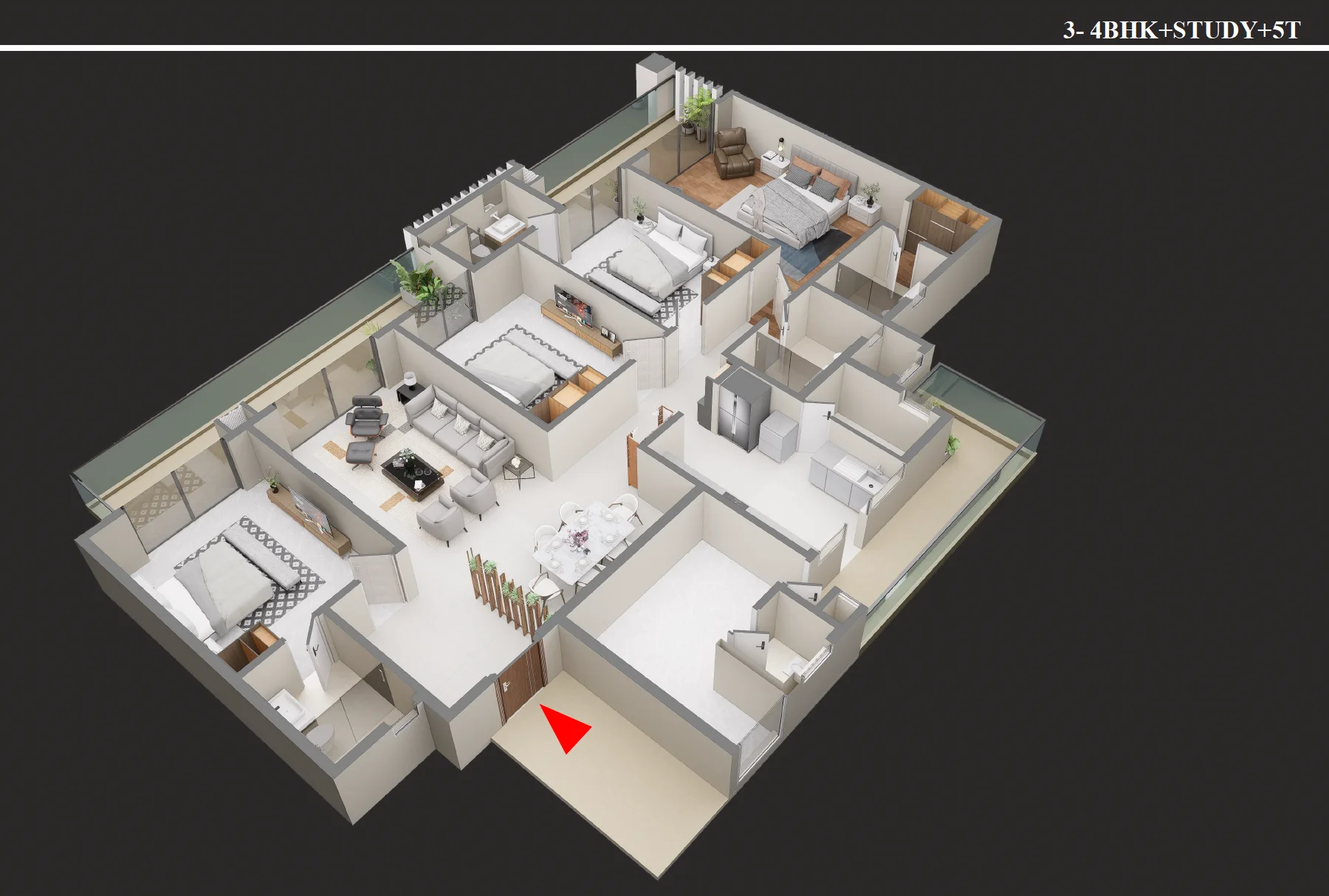
Forbes Fab Luxe Residences is eleven G+35 towers on a 13-acre site, with four homes per floor (3 BHK + study, and 4 BHK + study). The structural design is by a senior structural consultancy with extensive G+35 experience, the construction is by an EPC contractor, the audit and monitoring is by NBCC under a contractual mandate. The lateral system is RC shear walls and a perimeter-tied core, with no outrigger required. The foundation is a piled raft with friction piles. The slab is post-tensioned for the larger spans in living-dining and conventional RCC for the bedroom zones. The wind tunnel test was performed early in the design phase and the cladding pressures were used to specify the DGU façade. The lifts are 2.5 m/s gearless MRL with destination control. Refuge floors are at floors 9 and 18. Fire compartmentation is to the full NBC 2016 Part 4 requirement. Construction monitoring is by NBCC through every floor cycle. For the latest construction status, see the May 2026 construction update.
What the buyer should ask.
- What is the foundation type — raft, piled raft, or fully piled?
- What is the lateral system — shear wall, shear wall + outrigger, or moment frame?
- Has a wind tunnel test been performed, and is the report available?
- What is the slab specification — post-tension or conventional RCC?
- What is the lift speed, the lift type and the algorithm (collective or destination)?
- What is the refuge floor location, and is the pressurised stair fan ducted separately?
- What is the inter-storey drift target, and what is the design top-floor acceleration?
For the cross-network architectural perspective on G+35 towers, see Forbes Residences; for the location's regulatory and infrastructure context, see Forbes Noida Extension.
Frequently Asked Questions
How are G+35 towers built in India?
A G+35 tower in India is built on a deep raft or piled raft foundation, with a reinforced concrete shear-wall and core system carrying lateral wind and seismic loads. The lift core is the primary lateral element. Floor slabs are typically post-tensioned or conventional RCC at 200 to 250 mm thickness. Wind loads are validated by wind tunnel testing for towers above 100 metres. The full superstructure cycle on Forbes Fab Luxe is six to eight days per floor with mivan formwork.
What is the difference between a G+25 and a G+35 tower structurally?
A G+35 tower is taller by ten floors but the structural design is more than 1.4 times more demanding because lateral wind loads scale non-linearly with height. A G+25 typically uses a moment-resisting frame or a thin shear wall system. A G+35 requires a heavier shear wall plus an outrigger or belt truss at one or two intermediate floors to control lateral drift. The foundation is also deeper and more expensive.
Are G+35 towers safe in earthquake zones?
Yes — when designed under IS 1893 and IS 13920 with response spectrum analysis, ductile detailing, capacity-design philosophy and proper drift control. Greater Noida West is in Seismic Zone IV. Forbes Fab Luxe G+35 towers are designed for the full design earthquake, with shear walls dimensioned to remain elastic and confining reinforcement detailed in critical regions.
Why does a G+35 tower need wind tunnel testing?
For towers above approximately 100 metres in height, IS 875 Part 3 requires wind tunnel testing to confirm the static, dynamic and across-wind responses, including vortex shedding effects. The test produces base shears, base moments, accelerations at the topmost occupied floor, and cladding pressures. The data feeds directly into the structural design and the façade specification.
How fast does a G+35 lift travel?
For a G+35 residential tower, lift speed of 2.5 to 3.5 metres per second is standard. Forbes Fab Luxe specifies a 2.5 m/s gearless machine-room-less lift with destination control. At that speed, the worst-case waiting time on a peak-hour up-cycle is under 35 seconds and the round trip from ground to floor 35 is under 60 seconds.
See the full Fab Luxe G+35 specifications.
Eleven G+35 towers, NBCC-monitored, on 13 acres. 3 & 4 BHK from 2,690 sq ft.
View Technical Specs →